No photos yet
1Talya
Home reef Pearl Diving Center Talya is also known as Pearldiving, home reef.
BeginnerMax depth 9.8 ft
The top 89 dive and snorkel sites in Turkey, ranked by diver reviews, with maps and photos. Read the Turkey guide
Home reef Pearl Diving Center Talya is also known as Pearldiving, home reef.
This is a new wreck it's there since 1997, it was an accident with a local ferry (M/S Suadiye) and sunk immediately with no human loss. It's almost 50 meters long a metal ship, at the bottom of the sea its stays like at the surface sailing position and heading N/W direction, on the wreck there are many nets of the big fishing boats, before they understand there was wreck down. The wreck is in very good condition you can see every equipment on, its still undiscovered by diving community and diving courses. This rweck is between Heybeliada and Maltepe, you have to know the place and take care of boat traffic. Heybeliada - Karakaya Wreck is also known as Heybeliada - Kum Kosteri.
Yatakadasi is a 5.0-star rated scuba dive and snorkel destination in Turkey, Aegean, Izmir which is accessible from shore based on 1 ratings.
This is a narrow crack on a wall which is going into the land about 30 meters, some places are very narrow and there are fallen stones from the top of the crack and many of them ready to fall. At the end because of the fallen stones you have to stop and to come out of the water then to look to the ceiling in a way to get panic and try to go out of there. Also you can see some wild pigeons when you come at surface in the cave. It is a crack on the wall which the half of it is in the sea, you need a boat to go there. Büyükada - Pigeon Cave is also known as Peristerona.
Big Reef is a 4.0-star rated scuba dive and snorkel destination in Turkey, Aegean, Bodrum which is accessible from shore based on 1 ratings.
Recently sunk scuba attraction sitting dead flat on the bottom at 30 m. Good visibility and well marked shot line, deco stop done by chain at 5 m. Mostly stripped out so should be safe for penetration dives, not much in the way of wildlife present yet but it is only recently sunk. By boat from Oludeniz or Fethiye Coastguard Wreck is also known as CG121.
Mid Reef is a 0-star rated scuba dive and snorkel destination in Turkey, Mediterranean, Kalkan which is accessible from shore based on 0 ratings.
Mainly a sandy bottom with some rocks and sea grass; not a lot of great interest but good for training. Kalkan
Reef extending the north side of the island. Some stone anchors, amphorae. Normally no current on the western side of the reef. Changing on the eastern side. With current on the eastern side good chance to see a lot of fish (barracudas, mackerel and sometimes tuna hunting). Caretta caretta are spotted at this place frequently. By boat from Kas with one of the local diving centers.
An easy to dive reef in a depth range of 12-40 meters. Lot of ancient amphoras and cans. Sometimes sea-turtles.
The dive site consists of a reef approximately 3 nautical miles south of cape Ince Burun, surrounded by deep water. The ridge of the reef rises up to 3-5 m. On the one side it slopes down to a plateau at 20-30 m, on the other side is a wall that changes into a steep slope somewhere between 30 and 40 m. Pieces of wreckage, mostly pipes and plating, are strewn all over the reef. In some places there are also amphoras. On the plateau lie the remains of a small, steam-powered ship. There is not much left of its structure, only the bottom with keel and ribs and some lumps of coal strewn over it. The best preserved part ist he stern where remains of the steering mechanism can be seen. There are also parts of at least one boiler. The much more interesting wreck (or part of it) lies on the other side of the reef. On the top of the reef is a deep crack running diagonally over it. It was obviously torn during a wreckage, some pieces of metal are still wedged into it. Follow the direction of the crack and use your compass to keep it. Don't go down to the ground but keep a depth of around 30 to 35 m. If you watch the ground carefully, you can see a trail of wreckage leading to the wreck itself, for example a big part of the hull plating complete with railings. Because of the usually excellent visibility (sometimes more than 40 m), the main part of the wreck can be seen from some distance. The highest point is at 43 m where the ship is broken, at the corner of the deck and the port side. It's the bow part of a big cargo ship, at least 40-50 m long, lying on the starboard side with the bow down at a depth of more than 80 m. The decks are standing vertically, with some machinery (winches) still fixed to it and several open cargo hatches. Rows of portholes are running along the hull. There is a lot of small fish and the wreck has a beautiful cover of sponges and soft corals. To penetrate the wreck safely you need trimix, but because of the great visibility you can see the whole of it from the highest point. If you return to the reef, watch out for amphoras on the reef wall. The densely overgrwon reef itself is very beautiful. Amongst the animals that can be seen are hermit crabs, octopuses, lots of small fish, small and big scorpionfish, morays, schools of barracudas and mackerels and sometimes turtles. The reef is not only the best dive in the area, but one of the best in Turkey. There is some confusion surrounding the identity of the wreckage. A bell with the inscription 'Duchess of York - Hull 1893' was found close to the bow piece, indicating that the stern part on the plateau and the deep-lying bow part belong to one ship. However, the documents concerning the Duchess of York show that the shallow wreckage is probably all that remains from her. She was a two-masted sailing ship with an auxiliary steam machine, a length of 101 feet and 51 tons. She was built at Hull (England) in 1893, sold to a Spanish owner in 1902, renamed "Carmen" and sold again in 1919. After this date she disappears from Lloyd's lists. It is clear that the deep wreckage comes from another ship because both parts together would give a hull with at least 250 feet and 1.000 tons, much bigger than the Duchess of York was. Maybe the bell was thrown over the ridge of the reef by a boiler explosion. The devastated state of the wreck indicates a end of that kind. There is also a local tradition about a ship blowing up on the reef and some bodies being washed ashore sometime at the beginning of the 20th century. However, the eyewitness remembered that this happened during the First World War when the battle of Gallipoli was fought - this was in 1915 and some years before the Duchess disappeared, There are not many clues to the identity of the other wreck - whose stern probably lies in greater depth - except construction details like the wooden deck or the riveted hull that indicate a high age (probably early 20th century) and the information that a Turkish ship called Sakarya was lost on the reef sometime around 1957 while carrying a cargo of coal and chrome ore. Maybe it's the bow part of the Sakarya - or of another, unknown ship. By boat from Kas or Kalkan with one of the local diving centers.
On this site a a reconstruction of the ancient wreck that was found and excavated at Uluburun was sunk in 2006. A archaeology park emulating the original site of Uluburun was also set up there. By boat with one of the local dive centers.
Trigger Bay is a 0-star rated scuba dive and snorkel destination in Turkey, Mediterranean, Kemer which is accessible from shore based on 0 ratings.
Many amphorae, groupers, nudibranchs Black island Pinar 1 is also known as Black island.
One of the nicest diving site in Saroz both for beginners and advance divers. Right after Gelibolu exit for Findikli and once you reach the village watch the sign Komur Limani. From Findikli to diving site follow the dirt road.
The "St. Didier" is known as "Societe" as well. It's a freighter build in 1920 at Livingstone & Copper shipyard with a lenght of 70m and a beam of 12m. She has been under French flag and has been confiscated by the Germans during WW II. They used her, camouflaged as a hospital ship, for transport of supplies for their Africa Corps. On board have been Jeeps, guns, ammunition and other war materiel. With an escort of one destroyer she tried to reach Africa, while permanently and heavily attacked by allied aircrafts coming from Cyprus. Trying to get out of these attacks, together with their escort, she came close to the Turkish shore. While permanently attacked, both ships rechead the area of Adrasan, about 40 miles southwest of Antalya. Meanwhile the "St. Didier" was heavily damaged and nearly unable to continue their voyage. The escorting destroyer had to leave the "St. Didier" in attempt to rescue himself. The "St. Didier" tried to reach the harbour of Antalya in attempt to ask for asylum in Turkey. They still had the permisson of the Turkish authorities to wait in sight of the horbour for asylum. Meanwhile the French crew throwed away their uniforms and renamed the ship to "Societe", in hope not to be attacked any more. But they couldn't mislead the allied Mustangs. While the ship was only a few hundred metres off the shore and obviously in Turkish territorial waters, they continued their attacks and torpedoed the ship. Many residents of Antalya watched the attacks from the harbour and because many torpedoes missed their aim and one exploded directly in the harbour, one Turkish citizen was killed as well. Finally one torpedo hit the ship in an area where a lot of explosives were loaded. The following explosion lead to a giant hole in the ship. While sinking, a lot of seamen died. The others reached the shore or have been picked up by Turkish fishing boats. In accordance with international rules they have been brought to a camp near Isparta, but without status as prisoners. Today the wreck is lying within short distance of Antalya harbour at a depth of 20 - 32m. During excavations in 1946 and 1974, a major part of the ship's cargo was discovered, including ammunition and medical equipment. Although there is little left in the submerged ship, it is still attracting much interest from divers, and permission is required from the Antalya Goverment and Marine Police Department. San Didier Wreck is also known as Societe Wreck.
Lundy was a 188 tonned ship that has been completed in 1908 in England that was belonging to hull steam fishing&Ice co. ltd. Her machine was amos & smith. She was an unmilitary ship before the World War I. After the war started she had been taking by the army and send to Canakkale for use in the mine searching missions. There are three explanations of her usage before the war started; one saying she was a whale hunter, one saying she was a troll ship and one saying she was a cargo ship. If I can get more information about this wreck, I will share it with you here. Lundy is lying in 28-30 meters in Suvla bay between Buyuk Kemikli and Kucuk Kemikli capes. The ship's sunking is also not known exactly. There is two possibilities. One says that while allied forces retreat they sunked their ship, the other says that she has been mined or torpedoed. Because in one source it says that she sank in 16th August 1915, it is more possible that she was sunk by a torpedo or mine. In an other source it says that she sank by a collision in 16th of August 1915. Lundy Dive site is an easy and safe diving spot, with its complete hull. Because of these, two dives in one day can be made in this site. There is a lot of sea life around the wreck. Lobsters, sponges, groupers and other fish type colonies can be seen around the wreck. The ships lies in 28 meters with a little angle to the port side. While diving to the wreck, if you go to the stern you can see that this part of the ship has been damaged from something like a collision. Lundy has been sunked because of a collision from this part because of unknown reasons in 1915. The ship has been found by the fisherman around this region in 1987 and has been a very popular dive site for the last 8-10 years. This ship shows the specific hammerhead bow type and design of that period. Actually with its structure she seems like she was a small cargo ship. With the long bow of the ship the warehouses come to the attention. The outside of the warehouses has been completely vanished leaving just the skeleton of the structure. Because its topside was covered with wood, they were perished by the passing time and so divers can enter to this part of the wreck. You can get good photographs and videos in this part. But you should be very careful while entering here because of the muddy ground. Just one uncontrolled fin can change everything. If you look carefully you can see a lot of colorful sponges found a place on the ceiling of the warehouses. When you approach to the middle of the ship, you can see the machine rooms windows, port and starport hatches. We can find coal particules in the mud near warehouses because she was a steam ship. In the starport side you can see the passage way from the rotten walls to the machine room. Infront of the machine room there is a chimney opening where we can se the propeller that takes the air out. Unfortunately the chimney has been broken while she sunked. It is lying in the port side of the ship. There are lobsters where the ship meets with sandy bottom. On the sandy bottom around the wreck, different kind of ammunition can be seen. Sometimes its possible to see groupers in the chimney. The captain's chamber is to the back of the ship. Right inside there is a door and a window. When you go inside from here, you can see a small room and some beds around. To the center downwards there are leftovers of a closet. Its hard to understand what you see in the old wrecks like this, because of the sponges and alges that cover everything. After you penetrate the wreck, you should stop for a while and investigate around. The stern part of the ship lies on the sandy bottom where you can see the ships propeller stucked in the sand. For a photographer there are a lot of things for a good composition. Especially if you are planning wide angle photography, a fish eye objective is ideal for this wreck. The bow of the ship will make a good photograph subject also. Anchor and the captain's cabin can be photographed closer. You can take good photos from inside the warehouse. Also there a lot of subjects for macro photography. In order to make interesting dives to these wrecks, we should protect them, make no harm to them and we shouldn't take anything as a souvenier. By this, the new divers can also visit Lundy in a good undisturbed shape. Source : turkiye-wrecks.com
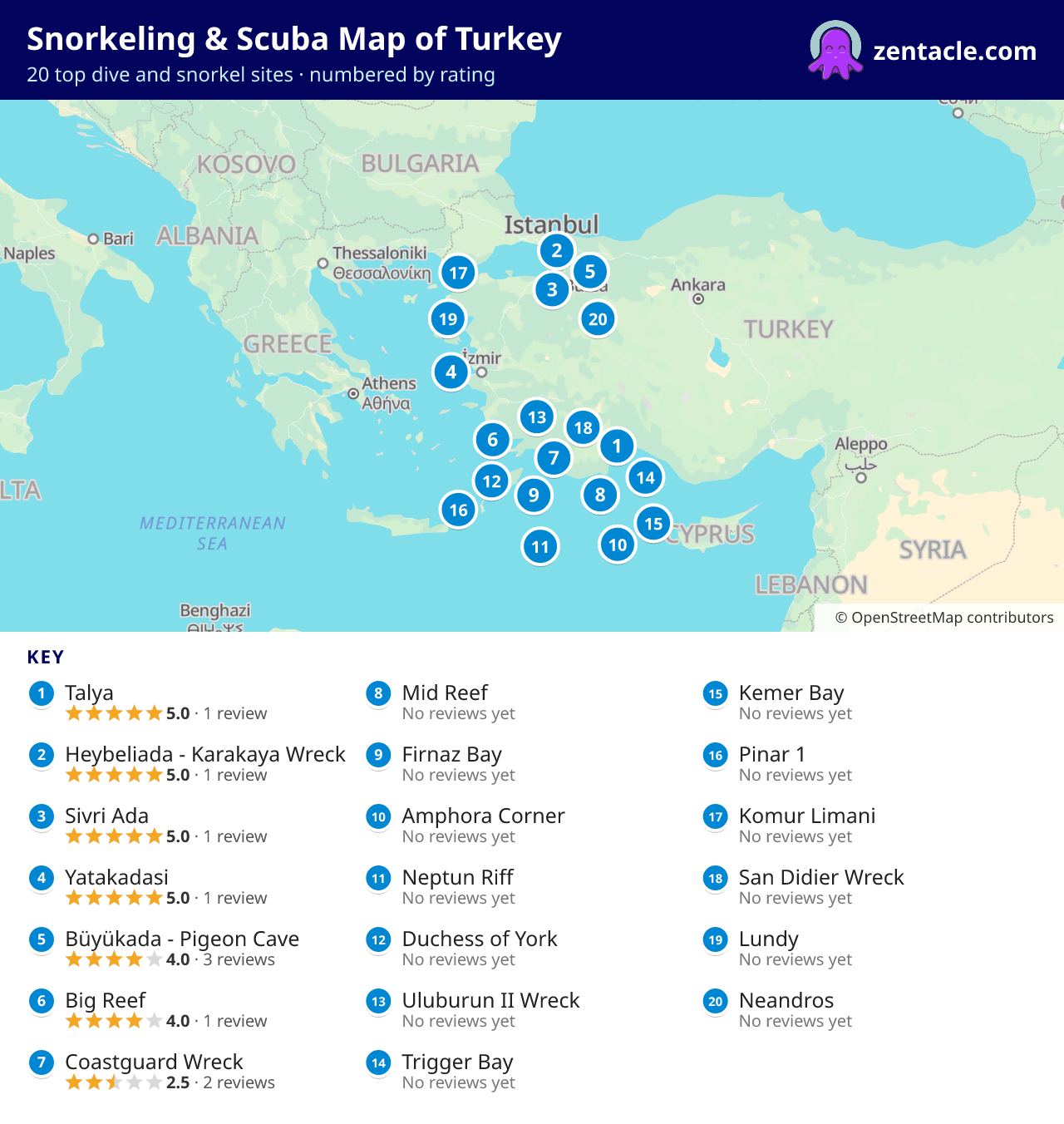
Based on Zentacle reviews, the top-rated sites in Turkey are Talya (5.0 from 1 review), Heybeliada - Karakaya Wreck (5.0 from 1 review) and Sivri Ada (5.0 from 1 review).
The top-rated beginner sites are Talya (5.0 from 1 review), Sivri Ada (5.0 from 1 review) and Yatakadasi (5.0 from 1 review).
Heybeliada - Karakaya Wreck (5.0 from 1 review), reached by boat, with a maximum depth of 65.6 ft.
Zentacle lists 73 dive shops in Turkey. The top-rated are Saros Diving (5.0 from 196 reviews) and Foca Dive Center (5.0 from 132 reviews).