No photos yet
1The Island of Fuerteventura
The Island of Fuerteventura has several shore dives where you even see sharks and lots of big rays.
Shore entry
The top 188 dive and snorkel sites in Canary Islands, ranked by diver reviews, with maps and photos. Read the Canary Islands guide
The Island of Fuerteventura has several shore dives where you even see sharks and lots of big rays.
Easy diving complications can admire the marine life is the owner of such structures. Species typical of sandy bottom most common species on the island. Access from boat, artificial reefs created by the University of Las Palmas for the regeneration of marine life in the area. Baja Pasito Blanco is also known as Reef Pasito Blanco.
Gran Canaria is an underwater resort on the south eastern tip that is only accessible from shore. Lots of moray eels, barracudas, huge mass of snappers, rays have been seen.
Nice boat dive. Lot's of different fishes here. Nice underwater volcanic landscape. By boat only
Interesting site to visit the protected black coral! By boat only. Black Coral is also known as Coral Negro.
Pasito Blanco Arrecife artificial is also known as Arrecife artificial de Pasito Blanco, Artificial Reef.
Reef running off from sea wall. lots of fish life in the area, with Rays, Barracuda, Morays, Angel Sharks and Amberjacks. Nice dive for fish life and photos. Beware of occasional currents on the dive site. Easy access from beach. Short swim to sea wall for start of reef. Playa Flamingo is also known as Flamingo Reef.
Nice dive site with a big mushroom like rock. Nice rock formations and underwater canyon. By boat only The Mushroom is also known as Mushroom Las Galletas.
Boat or Shore Dive 32m--The Cathedral is a large natural cavern in the reef wall. Its entrance is about 10 metres tall. It's best to approach the Cathedral from mid-level on the wall or from above over the sand. Take a torch to see the abundance of life on the walls and roof and in the innermost point, which is like a small garden and is home to Cardinalfish and large Grouper. There are Yellow Horn Corals, Tube Worms and Prawns in the end, and Jewel Anemones, Cup Coral, Sponges and Sea Mat on the roof. Look out for Moray Eels near the entrance and don't miss the sight of the bubbles percolating through the rock and sand above the Cathedral on your way back. LANZAROTE, situated approximately 95kms off the west coast of North Africa, is a volcanic island rising out of the deep Atlantic Ocean. It is the most northerly of the 7 Canary Islands and is on the same latitude as Florida and the Red Sea. Lanzarote benefits from a sub-tropical climate with more days of sunshine and fewer days of rain than the other Canary Islands.
Boat or Shore Dive 32m -- This dive can start from the shore at Playa Barrilla or can be from the boat. The dive goes along the wall at the edge of the reef where there are lots of nooks and crannies to explore. Life on the wall is good; there are Sponges, Sea Mat, Sea Squirts and amongst them are Nudibranchs; but also look out to sea where there may be Barracuda, Grouper and Rays. There is a memorial to Dieter, a previous dive centre owner, at 30 metres and a small growth of pretty Red Tree Coral in an overhang at 28 metres. The dive continues over the sand on top of the reef where there is often a Grouper waiting for the divers. LANZAROTE, situated approximately 95kms off the west coast of North Africa, is a volcanic island rising out of the deep Atlantic Ocean. It is the most northerly of the 7 Canary Islands and is on the same latitude as Florida and the Red Sea. Lanzarote benefits from a sub-tropical climate with more days of sunshine and fewer days of rain than the other Canary Islands.
The entrance to the sea by the same zone where sea water enters the salt and have to take a small jump. With good weather you can get out of the sea almost anywhere, but with bad weather there is the possibility of escape through an area of natural rock, which he called The Puertito, which is about 100m further north. At the leeward Puertito (rock shelter) there is a hallway with the depth that you can exit without problems, although it is somewhat difficult to find only indications, so we recommend that you go with someone who knows the area, at least the first time. Enjoy. Access to this point dip from the coast is situated in the extreme north of the Salt Museum in Las Salinas del Carmen.
Nice scenic dive lots to see easy conditions and good vis.Blue hole a large swim through dropping from top of the wall in 20m to wall face at 30m. Access via harbour steps and short surface swim. Agujero azul is also known as El Hoyo, Blue Hole.
A trench with a sand bed surrounded by volcanic formations with small caves and cracks. The sandy center is at 16m in depth, with some Eagle Rays, as well as Angel Sharks. In the surrounding rocky areas and small caves are Canarian Lobsters, Groupers, Zebra Breams, Parrot Fish, Amber Jacks, Barracuda's, Saddled Breams, Bermuda Sea Chups, Cow Breams, Guelly Jacks and Morays to be found. Southeast of the isle of Lobos.
The bottom is a mixture of basaltic formed volcanic rocks, shaped like huge mushrooms, with loose rocks around the bottom. The rocks are up to 10m in height. Species hiding around these rocks are Black Bream, Zebra Bream, Ornate Wrasse, Parrot Fish, Guelly Jacks, Trumpet Fish, Cow Breams, Saddled Breams, Morays, Barracuda, Blue Fin Damselfish, Canarian Lobsters, Groupers, Amberjacks, Eagle Rays, Sting Rays, Trigger Fish, Scribbled Filefish, Glass Eyes, Trumpet Fish, Angel Sharks, large Scorpion Fishes and schools of Barracuda's. The dive is situated approximately in the middle of the channel, 5 minutes by boat from the port of Corralejo.
Dive site is named after a large number of old anchors found there. It is a trench found along the reef that stretches from Corralejo to Playa Blanca (Lanzarote). You can find many types of rays as well as lobsters, Barred Hog Fish, Groupers, Breams, Barracuda's, Glasseyes, and the occasional deep sea fish. North of Corralejo, towards Playa Blanca (Lanzarote), 2 miles off shore
Apart from a little reef close to the shore not much to see here. Very shallow region with sandy and rocky bottom. Easy access from the shore
Advanced divers cos of the currents. Great marine life: Dolphins, barracudas, jacks, lobsters, angel sharks... 3km from Las Galletas harbour
The Asshole its name is a pretty fucked up access. But it's worth. The name and location shown on Google Earth are fine, but there is another entrance about 200 meters north. In the "El Cabrón" can be made several dives, the more normal is "Los Roncadores" that is 20-22 meters deep max. You can take evening and Fotosub. Access from Arinaga
Along the reef, with its edges and crevices, gather huge swarms of breams, zebrabreams and guelyjacks. In the slots and holes several moray eels are at home: tigermorays, black moray eel and big mask morays are all very common here. A bit further away from the reef on the sandy areas we meet stingrays, eaglerays and angelsharks.
El Tazar is a 0-star rated scuba dive and snorkel destination in Canary, Fuerteventura which is accessible from shore based on 0 ratings.
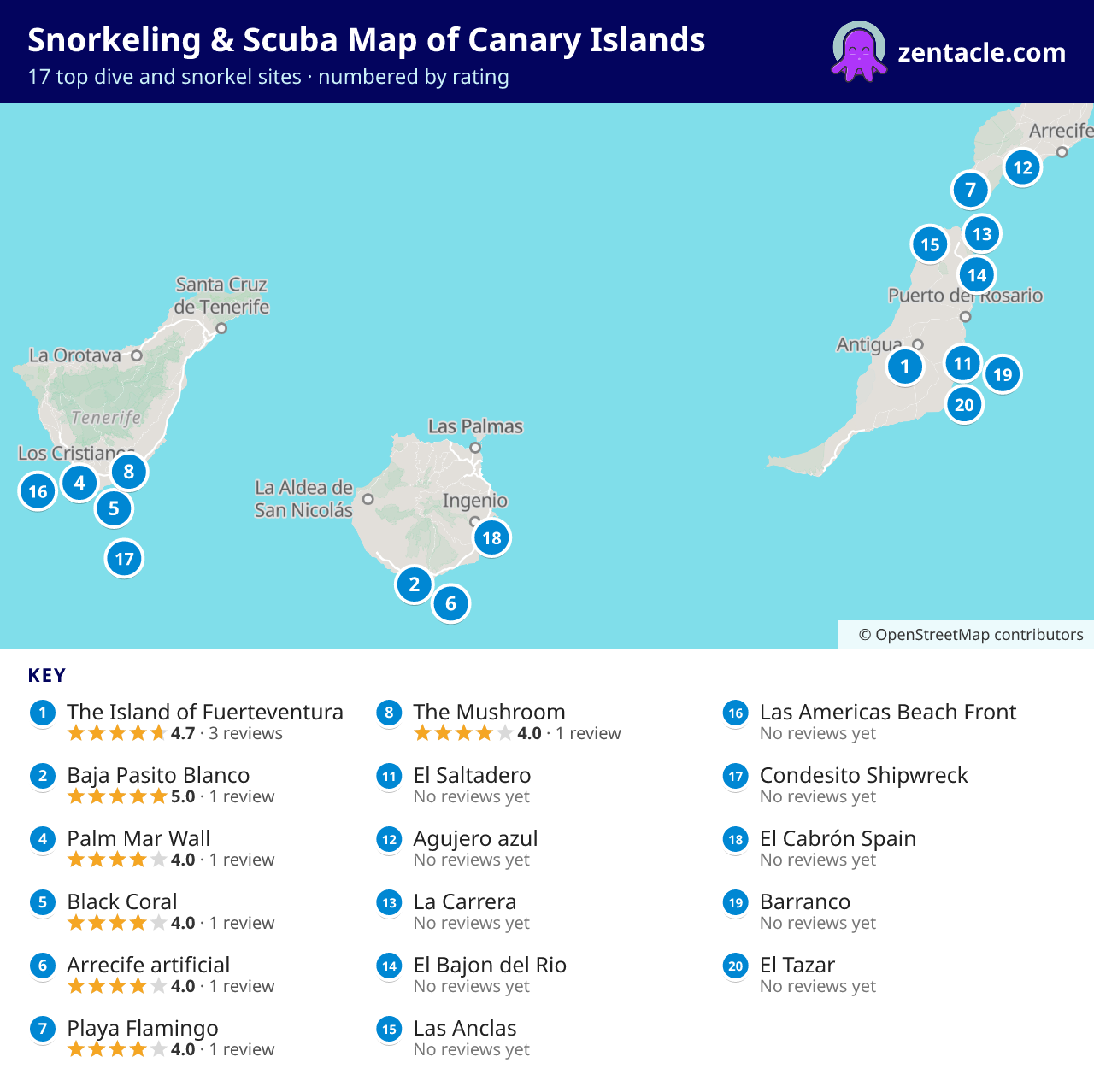
Based on Zentacle reviews, the top-rated sites in the Canary Islands are The Island of Fuerteventura (4.7 from 3 reviews), Baja Pasito Blanco (5.0 from 1 review) and Gran Canaria (5.0 from 1 review).
The top-rated beginner sites are Palm Mar Wall (4.0 from 1 review), Arrecife artificial (4.0 from 1 review) and Playa Flamingo (4.0 from 1 review).
The Island of Fuerteventura and Gran Canaria are the top-rated sites you can enter from shore.
Black Coral (4.0 from 1 review), reached by boat, with a maximum depth of 98.4 ft.
Zentacle lists 56 dive shops in the Canary Islands. The top-rated are Mojo Dive (5.0 from 855 reviews) and Leagues Ahead Diving (5.0 from 268 reviews).