No photos yet
1Big Reef
Big Reef is a 4.0-star rated scuba dive and snorkel destination in Turkey, Aegean, Bodrum which is accessible from shore based on 1 ratings.
BeginnerMax depth 59.1 ftBoat entry
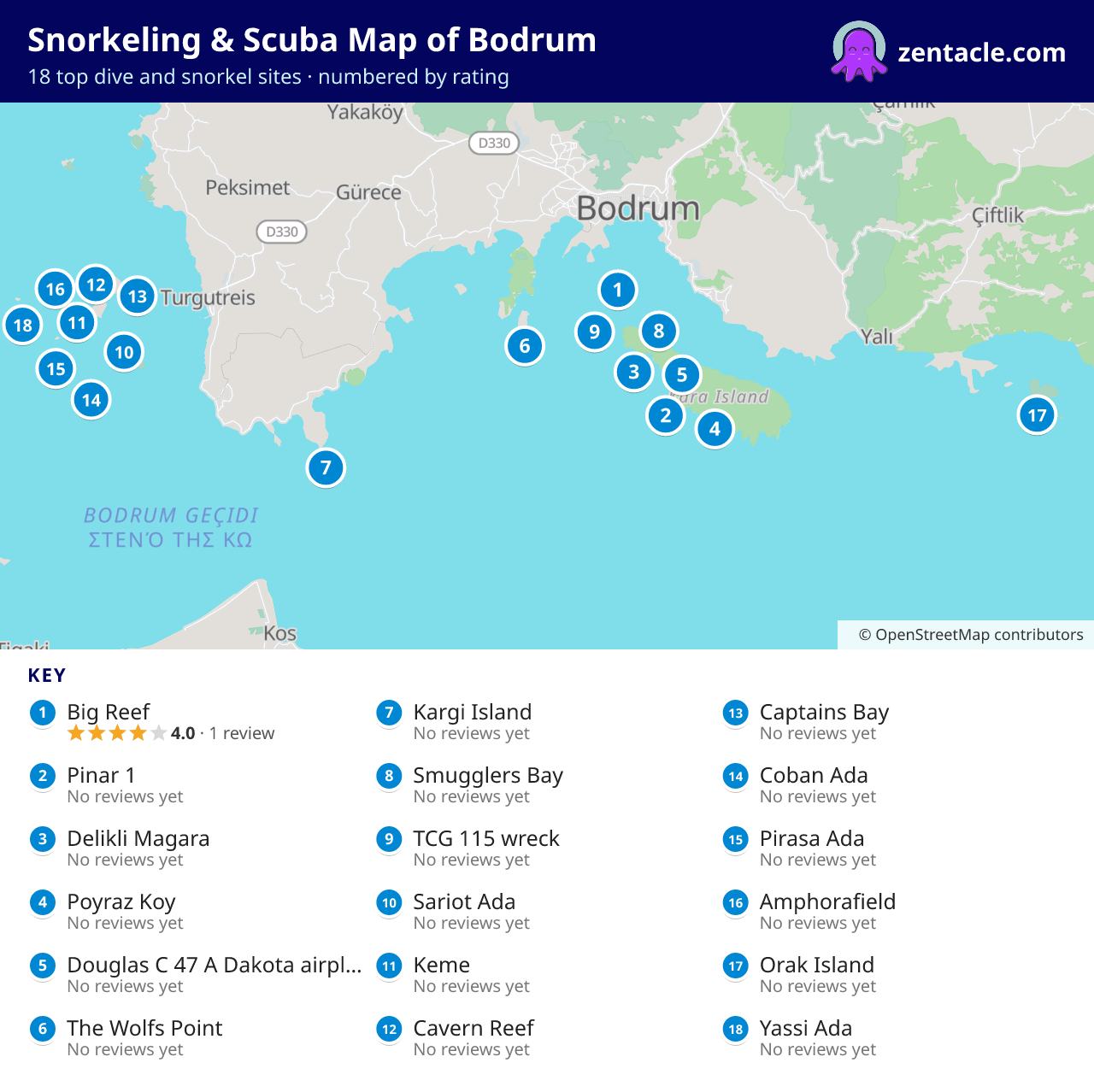
The top 18 dive and snorkel sites in Bodrum, ranked by diver reviews, with maps and photos. Read the Bodrum guide
Big Reef is a 4.0-star rated scuba dive and snorkel destination in Turkey, Aegean, Bodrum which is accessible from shore based on 1 ratings.
Many amphorae, groupers, nudibranchs Black island Pinar 1 is also known as Black island.
Delikli Magara is a 0-star rated scuba dive and snorkel destination in Turkey, Aegean, Bodrum which is accessible from shore based on 0 ratings.
Poyraz Koy is a 0-star rated scuba dive and snorkel destination in Turkey, Aegean, Bodrum which is accessible from shore based on 0 ratings.
It's an out sorted C 47 A Dakota from the Turkish Air Force, intentionally sunken on 1st of July 2008 for scuba diving. Overall length is 19,57m with a span of 28,96m, equipped with two Pratt&Whitney R-1830-93 engines. Originally it was mostly used for transport of paratroops. Originally located in shallower waters, by the storms and currents of the last winters, meanwhile the wreck is broken apart and it glided down to its present depth. According to Turkish diving laws the minimum diver qualification for this depth is CMAS**/AOWD. Meanwhile I don't recommend diving inside any more, because of the instable structure and a lot of stuff dangling around. Also entering is not necessary because everything of interest can be seen from outside. Douglas C 47 A Dakota airplane wreck is also known as Pacoz Bay.
One of the medium-level difficult dive sites around the Bordum peninsula. The surface and deep streams are usually strong. IT's a wall-type dive which starts from the south-eastern cove of the island. Reef structures are formed and species of Moray, Congar Eel, Groupers and Barracudas can be observed. Rarely, Caretta Caretta sea turtles can be seen at the bottom. Very joyful dive site... Kargi Island is also known as Kargı Adası.
An ideal point for both advanced divers, open water divers and beginners. It is possible to dive into two directions of the bay. Look out for moray eels in the numerous cracks in the rocks. The rock formations go down to approximately 26 meters deep. Groupers will be encountered along with several other small species of fish. It's common to encounter the cave sweepers different species of sponges in a small cave inside the bay. Bodrum
TCG 115 is a former Turkish Coast Guard Boat intentionally sunken on 16th July 2007 for scuba diving. Draught has been 1,40m with a displacement of 70 tons. It has been equipped with two 1360 hp Mercedes engines which allowed a max. speed of 18 kts. Arming has been one 40/56mm Bofors gun and two 20mm Oerlikon machine guns. The crew has been 1 officer, 5 NCOs, 2 contracted NCOs and 8 enlisted men. The engines and other potential hazardous material had been removed before sinking the boat. Now the wreck is lying between 19-27m, so according to Turkish diving laws, minimum certification requirement for diving this wreck is CMAS**/AOWD. It is perfectly suitable for first wreck diving experience. TCG 115 wreck is also known as Kara Ada.
Actually Sariot Ada is the wrong name for the dive site, because the dive site isn't Sariot Ada but a reef a few hundred metres south of the island. Jagged tips of volcanic rock reach up to short above sea level. Underwater the rocky landscape goes down to about 30m, followed by gentle dropping sand ground. Between the rocks you will find the whole diversity of the marine life of the Aegean Sea. Right next to the tips of the reef there is a quite shallow area with between 6-9m. But following the slope of the reef you will reach fantastic rocky scenery which is reaching down to about 30m. If you turn west now, you will find an ancient anchor. At that point it's time to turn northeast, back to shallower waters and to the boat. Quit regularly you will meet groupers of considerable size, big moray eels and giant schools of barracudas. Big amberjacks may be seen as well. Sariot Ada is also known as Yellow Grass Island.
Keme is the top deep dive spot of Turgutreis. The dive boat anchors in a small bay. Starting in that bay you will dive along a wall, over a sea grass field, down to approximately 12m. There a deep wall starts, going down to about 70m. So it's no problem to reach the Turkish legal maximum depth of 42m here. And this depth actually makes sense here, because the vegetation of the wall is magnificent in the area between 30-40m. Also brilliant is the panoramic view, no matter if you look down towards the ground or upward to the surface. In return fish are a bit rare at Keme, but nevertheless, with a little luck you may see some groupers or moray eels as well. At about the middle of the dive you will turn back and into shallower waters. Although the wall is step, the place is suitable for inexperienced divers as well. The wall doesn't just drop vertical. There are a lot of terraces and ledges. So if you always stay close to the wall, an uncontrolled descend is not possible. So the less experienced divers may watch their more experienced fellows from shallow waters. Keme is also known as Sican Ada.
Cavern reef is situated at the western side of Catal Ada. The tips of the reef are above sea level. The main reef is approximately horseshoe-shapped with the open side of the horseshoe westward. Usually the dive boat will anchor at the outside of the reef which is facing Catal Ada. While diving I recommend to start diving along this outside of the reef. In about 12m depth the horseshoe is ending in a sea grass field. If you now continue descending in the given direction, over the sea grass field, in about 18m you will reach a rocky area. Continue following the original direction over the rocky area, you will reach a second, small reef which tips are reaching the surface as well. The bottom of this reef is in about 35m and in that area you will find groupers and moray eels of considerable size. Following the bottomline of the reef you will reach an ancient stone anchor. At that point start following the backside of the reef towards shallower water and the rocky area again. All the way you will find the whole diversity of the marine life of the Aegean Sea. Later on, over the sea grass field, back to the horseshoe, you should try to find the inside of the horseshoe. There you will find two small caverns. Their walls are really nice covered with marine life. Through both caverns it is easily reach the outside of the reef and to dive back to the boat. You don't need any torch for that. At every time and from every place in the caverns it is possible to see both exits.
Because Captains Bay is a very shallow area, it is perfectly suited for beginners. Nevertheless a dive at Captains Bay is never boring, due to a marvellous small reef. Diving from the dive boat for a short distance over sand and sea grass, you will reach the reef. The reef starts in about 6m and extends to a maximum depth of 14m and with its rich and beautiful marine life it reminds me of some tropical reef. Even seahorses have been sighted here. Due to the shallow waters, light is excellent there and so it's a perfect location for macro photographers. But it is a well a perfect location for non-photographers, interested in marine life. If there is enough air in your tanks, after the exploration of the reef, you may dive back over sand and sea grass, basing by the boat, to the coast of Catal Ada. In that area the maximum depth is 8m and you may find a lot of octopuses and moray eels. Captains Bay is one of the dive sites which usually can be visited from Turgutreis even if the weather conditions are not ideal. Captains Bay is situated in a very wind protected position at Catal Ada so that it is nearly always possible to dive there and currents are very low.
The official name of Coban Ada is Kücüktüllüce Ada, but it is much better known as Coban Ada which means Shepherds Island in English. Coban Ada is one of the more remote dive sites of Turgutreis but anyway you can reach it in short time. Because the island is quite far out in the open sea you always have to expect currents. Therefore and because at Coban Ada depth up to 40+m are easy to reach, Coban Ada is a dive site more suitable for experienced divers. Because it's a small island it is possible do a full round during one dive. At the beginning of every dive you have to check the currents. Anyway, if you do a full round you have to expect a change in the direction of the currents. Because of its exposed position you may expect big schools of barracudas, amber jacks and occasionally tunas. Beside, between the rocks of the island you will find the whole rich diversity of the marine life of the Aegean Sea. Coban Ada is also known as Kücüktüllüce Ada.
One anchor spot is located at the southeastern tip oof the island. From the dive boat you will follow in southeastern direction the slope of the island, over terraces into a depth of more than 50m. Because of the terraces the place is anyway suitable for divers of all levels. Simply stay within a depth range which is appropriate to your experience level. And because in Turkey a licensed dive guide is required by law, he will take care that it is like that. An unintentional drop down is nearly impossible. The other anchor spot is at the side of the island, opposing Catal Ada. Here the dive boat will anchor a shallow field of sea grass. With a lot of luck, here you even may find some seahorses. Usually you will start the dive clockwise around the island. Over the smoothly dropping sea grass field again you will reach the terrace area. Because the island is to big to surround it in one dive, later on you will dive back the same route, but in shallower water. Here as well it is very easy to adapt the depth to the experience level of the group. Generally fish are quite rare around Pirasa Ada. Therefore the landscape underwater is very interesting and you will find a lot of small marine life. Pirasa Ada is a small island located at the northwestern side of Catal Ada. There are two anchor spots at the island. They will be chosen depending on the wind situation.
As the name implicates, you will find a mass of amphora parts there. Unfortunately intact amphoras are not amongst. Immediately right hand of the amphora field, with origin at Catal Ada, a small reef is going sloping into the sea. Usually the dive boat will anchor left of the reef, directly above the amphora field which is a depth between 3-8m. There are assumptions that in ancient times a ship was anchoring in a similar way, while a storm came up and threw it against the island where it was shattered. For diving I recommend to leave the amphoras unattended in the beginning of the dive and to follow the reef into the depth. The reef is going down to nearly 50m and it is really nice encrusted. While descending, between big rocks a huge amount of marine life is to be found. Later on the area of the amphorafield, because it is directly under the boat, is the perfect location for to empty your tank, while doing your deco or an extended safety stop. Amphorafield is located at the northwestern coast of Catal Ada.
Because of a small reef southwest of the island and reaching to only 1-2m below the surface, Yassi Ada is a permanent danger for ships for thousands of years. Already in the 1950s sponge divers from Bodrum have found the relics of ancient ships here. In the 1960s these wrecks have been explored by archaeologists under guidance of 'the father of modern underwater archaeology', the American Prof. Dr. George F. Bass and with contribution of the renowned American journalist Peter Throckmorton. It is assumed that in minimum 25 ships are sunken in that place. Three of them have been identified, one from 4th century, one from 7th century and one from 16th century. A lot of artefacts have been recovered at that time. Most of them today are exhibited in the Bodrum Museum of Underwater Archaeology, the only one in whole Turkey. The museum is located in the famous landmark of Bodrum, a St. John's castle from 15th century. Anyway a lot of artefacts are still in place on the sea ground at Yassi Ada. Exactly in the same place in 1993 the Lebanese freighter Mirna-M shared the destiny of the ancient ships and sunk on top of them. She has been under Croatian flag and here home port has been Rijeka. Mirna-M has been built in 1979 in Japanese Kurushima shipyard. Her length is 151,35m and her beam is 26,00m. There is nothing known about her cargo. Because of the ancient wrecks the area is restricted area for scuba diving. But in 2009, together with a BBC team which had a special permission from the Turkish ministry of cultural affairs and had been accompanied by the director of the Bodrum Museum, Mr. Yasar Yildiz, I had an opportunity to dive there and to take some pictures. Meanwhile rumours are going that the Turkish authorities consider opening the area to the public. But as usually in Turkey, things need time. The bad news first, this dive site is not accessible to the public. Yassi Ada is also known as Wreck Mirna-M.
Zentacle lists 3 dive shops in Bodrum. The top-rated are Turkuaz Diving Center (4.6 from 101 reviews) and Dive Academy Bodrum (4.0 from 67 reviews).