No photos yet
1Veturia Wreck
Veturia Wreck is a 0-star rated scuba dive and snorkel destination in USA, North Carolina, Cape Hatteras which is accessible from shore based on 0 ratings.
BeginnerMax depth 40 ftBoat entry
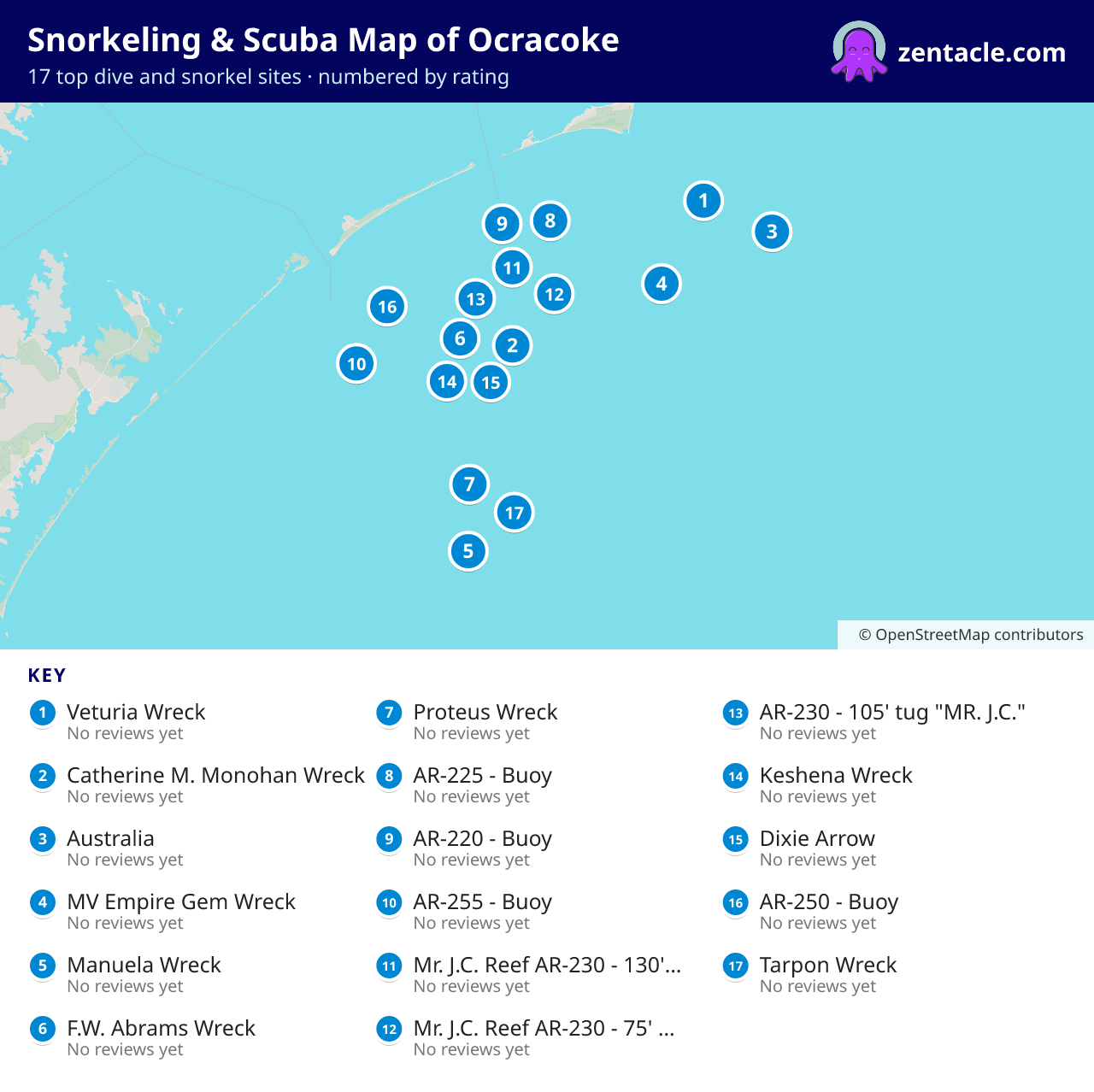
The top 17 dive and snorkel sites in Ocracoke, ranked by diver reviews, with maps and photos. Read the Ocracoke guide
Veturia Wreck is a 0-star rated scuba dive and snorkel destination in USA, North Carolina, Cape Hatteras which is accessible from shore based on 0 ratings.
Catherine M. Monohan Wreck is a 0-star rated scuba dive and snorkel destination in USA, North Carolina, Cape Hatteras which is accessible from shore based on 0 ratings.
Proteus Wreck is a 0-star rated scuba dive and snorkel destination in USA, North Carolina, Cape Lookout which is accessible from shore based on 0 ratings.
Railroad boxcars: 8 35° 06.868' / 075° 39.541' 35° 06.868' / 075° 39.556' 35° 06.788' / 075° 39.343' Miscellaneous concrete items: 7 105 tons 35° 06.773' / 075° 39.250' 35° 06.716' / 075° 39.321' 35° 06.673' / 075° 39.360' 6.2 nm from the Hatteras Inlet sea buoy
Railroad boxcars: 9 35° 08.150' / 075° 40.803' 35° 08.102' / 075° 40.696' 35° 08.093' / 075° 40.755' 35° 08.105' / 075° 40.752' Concrete items: 5 (75 tons) 35° 08.111' / 075° 40.822' Miscellaneous concrete items 35° 08.067' / 075° 40.633' Reef Balls®: 200 (large area) 35° 08.110' / 075° 40.574' 35° 08.099' / 075° 40.550' 35° 08.066' / 075° 40.540' 35° 08.055' / 075° 40.613' 35° 08.055' / 075° 40.540' 4.9 nm from the Hatteras Inlet sea buoy
Railroad boxcars: 10 34° 55.533' / 075° 57.867' 34° 55.467' / 075° 57.950' Concrete pipe 34° 55.483' / 075° 57.953' High Profile units: 10 steel pyramids 34° 55.500' / 075° 57.900' Concrete rubble: 80 tons 34° 55.533' / 075° 57.950' to 34° 55.517' / 075° 57.867' Old Hobucken Bridge steel truss span, 150' 34° 55.517' / 075° 57.867' to 34° 55.467' / 075° 57.950' 6.1 nm from the Ocracoke Inlet sea buoy
3.5 nm from the Hatteras Inlet sea buoy
3.5 nm from the Hatteras Inlet sea buoy
3.5 nm from the Hatteras Inlet sea buoy AR-230 - 105' tug "MR. J.C." is also known as Mr. J.C. Reef AR-230 - 105' tug "MR. J.C.".
Keshena Wreck is a 0-star rated scuba dive and snorkel destination in USA, North Carolina, Cape Hatteras which is accessible from shore based on 0 ratings.
An oil tanker sunk in WWII. It has a lot of different fish and is sometimes frequented by Sand Tiger sharks. There are usually lots of rays as well as fish hiding in the wreck. It takes two dives to see everything. The wheel house is off the wreck and visible, as are most of the engines and boilers. You can swim through some parts of the wreck, but the real draw is the amount of marine life. Sometimes there is a current, but usually there is none. Temperatures are fairly warm since it is in the gulf stream. Wet suits are not necessary due to this. Boat only. They usually leave from the Inlet near the Ocracoke Ferry.
Railroad boxcars: 10 34° 56.679' / 075° 55.104' Concrete rubble: 500 tons 34° 56.917' / 075° 54.767' 34° 56.967' / 075° 54.783' 34° 56.917' / 075° 54.817' 34° 56.933' / 075° 54.833' 34° 56.983' / 075° 54.833' 34° 56.983' / 075° 54.817' Old Fairfield Bridge steel truss span, 220' 34° 56.787' / 075° 54.811' - SW end 34° 56.794' / 075° 54.804' - NE end Concrete box sections: 450 tons; 188 pieces Laid in a rectangular pattern running NE to SW 07&09-Nov-05 and 07-Feb-06 34° 56.929' / 075° 54.985' - NE corner 34° 56.907' / 075° 54.985' - SE corner 34° 56.899' / 075° 54.018' - Site Center 34° 56.876' / 075° 54.061' - NW corner 34° 56.874' / 075° 54.043' - SW corner 5.1 nm from the Ocracoke Inlet sea buoy
Name: USS Tarpon (SS-175) Builder: Electric Boat Company, Groton, Connecticut Laid down: 22 December 1933 Launched: 4 September 1935 Commissioned: 12 March 1936 Decommissioned: 15 November 1945 Struck: 5 September 1956 Fate: Sold for breaking up, 8 June 1957; foundered off Cape Hatteras, 26 August 1957 General characteristics Class and type: Porpoise-class diesel-electric submarine Displacement: 1,316 tons (1,337 t) standard, surfaced 1,968 tons (2,000 t) submerged Length: 287 ft 0 in (87.48 m) (waterline),[4] 298 ft 0 in (90.83 m) (overall)[5] Beam: 25 ft ¾ in (7.6 m)[3] Draft: 13 ft 9 in (4.19 m)[5] Propulsion: (as built) 4 × Winton Model 16-201A 16-cylinder two-cycle diesel engines, 1,300 hp (970 kW) each, driving electrical generators through reduction gears 2x120-cell Exide VL31B batteries 4 × high-speed Elliott electric motors, total 2,085 hp (1,555 kW) three General Motors six-cylinder four-cycle 6-228 auxiliary diesels[7] (re-engined 1942) 4 × GM two-cycle Model 12-278A diesels, 1,200 hp (890 kW) each two shafts 4,300 shp (3.2 MW) surfaced 2,085 shp (1.6 MW) submerged Speed: 19.5 knots (36 km/h) surfaced 8.25 knots (15 km/h) submerged Range: 6,000 nautical miles (11,000 km) at 10 knots (19 km/h) 21,000 nautical miles (39,000 km) at 10 knots (19 km/h) with fuel in the main ballast tanks (bunkerage 85,946-86,675 U.S. gallons {325,592-328,353 liters}) Endurance: 10 hours at 5 knots (9.3 km/h), 36 hours at minimum speed submerged Test depth: 250 ft (76 m) Complement: 5 officers, 49 enlisted Armament: 6 × 21-inch (533 mm) torpedo tubes (four forward, two aft, 16 torpedoes) (two external bow torpedo tubes added 1942; total 18 torpedoes) 1 × 4-inch (102mm)/50 caliber deck gun two 0.3" (7.62mm) machineguns