No photos yet
1HMS Montague
14,000 ton Battleship, lost 29th May 1906 in Fog. Much scattered & broken up, but armour plate still to be found
IntermediateMax depth 32.8 ftBoat entry
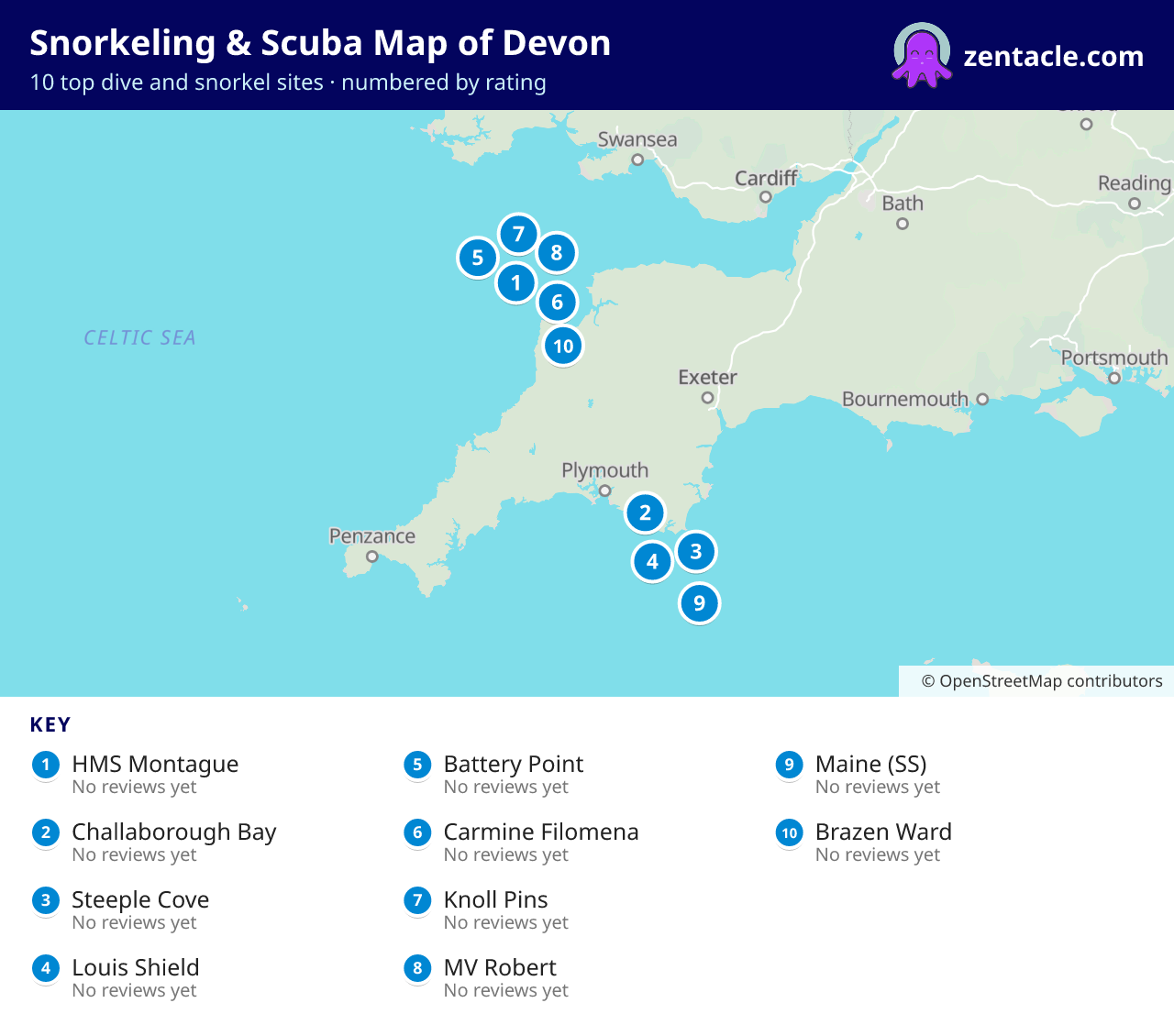
The top 10 dive and snorkel sites in Devon, ranked by diver reviews, with maps and photos. Read the Devon guide
14,000 ton Battleship, lost 29th May 1906 in Fog. Much scattered & broken up, but armour plate still to be found
The dive site is an easy access dive site used by Tai Diving located at the holiday park for training and underwater photography. Weather major factor as wind can cause the dive to be canceled as it blows straight into the bay causing strong rip and under currents. Marine life is good dog fish/shark cuttle fish crabs spider crabs and the usual fish. Dangers :- surfers and dive boats being launched Dive site is access from beach which has gradual gradient and has close by parking for easy access to the beach by steps or slip way
Lovely boulders covered in red algae, Lots of Sea Hares, not much kelp despite being shallow. A great second dive to bimble and enjoy the wildlife. Can be a bit of a swell. Out of Salcombe & Turn West
A lovely dive for novices, and well sheltered from Easterly winds. The wreck used to stand clear at low water, but has now broken up more, There are still large recognisable sections of hull and the boilers are exposed and easy to find. Lots of fish life, and some of the largest conglomerations of Snakelocks anenomes I have ever seen are just N of the wreck. 200m swim from the beach to access this well broken wreck. The Golf club offers green field parking, and there is another car park further on. Louis Shield is also known as Thurlstone Beach.
Rugged granite bedrock with gullies, canyons and cliffs which are particularly well developed off the northern side of Jenny's Cove. Lundy Island
The seabed near to the shore off surf point is of rock outcrops in sand. The wreck of the 'Carmine Filomena' lies below surf point here and is mainly a pile of plates with some ribs and overhanging surfaces. Good for nudibranch spotting. Lundy Island
These are two pinnacles, the tops of which are exposed during low water. The pinnacles are covered with life, from the kelp canopy at the top down to the burrowing anemones on the silty bottom. Lundy Island
The Robert sank in 1975 and now lies intact on its starboard side. It is best dived at low water slack, but this wreck is diveable on nearly all of the flood tide. There is a strong current on ebb tide, especially during spring tides. Depths of 22m to the bottom at low tide, 28m at high. A good sized wreck for one dive. Excellent dive worth making the effort, vis usually good. The quality of marine life on this wreck is outstanding. A torch is recommended for close inspection into the hull where you may see the odd lobster. Lundy Island. You will need an echo sounder and GPS to find the wreck as there are no surface markers.
The wreck of the S.S. Maine is owned by Torbay BSAC, who salvaged the bronze propeller to help fund the purchase of a dive boat. Later, then spare steel propeller was recovered, and displayed in a shopping complex in Paignton. Unfortunately, the council redeveloped the site, and gave the propeller away. The Bell was recovered by Bracknell BSAC and handed over to Torbay, woh still display it in their compressor room on Torquay Harbour. The wreck is suffering from the ravages of the winter storms along the UK coast, but is still a very interesting dive. Launch from Salcombe Maine (SS) is also known as Sierra Blanca.
Dive about 50m offshore of Frenchmen's Landing (the north side) and continue east for cliffs and rock slopes (similar topography to the intertidal area).
Zentacle lists 2 dive shops in Devon. The top-rated are Easy Divers (5.0 from 13 reviews) and Teign Diving Centre (4.3 from 23 reviews).